By CCodeLearner
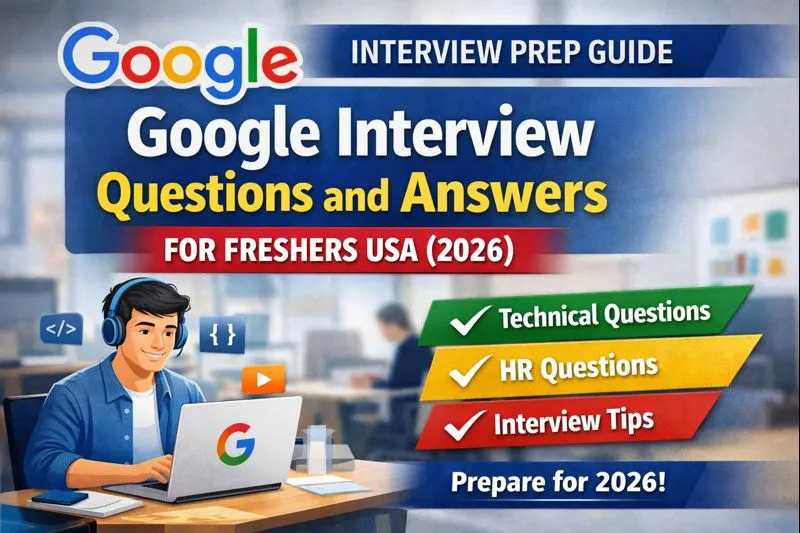
Getting hired at Google is a dream for many fresh graduates in the USA. Known for its innovative culture, competitive salaries, and challenging interview process, Google looks for candidates who are strong in problem-solving, computer science fundamentals, and cultural fit. If you are preparing for a Google interview in 2026, understanding the most frequently asked questions is essential.
This complete guide on Google Interview Questions and Answers for Freshers (USA) – 2026 is designed to help you prepare confidently with commonly asked technical, behavioral, and HR questions along with clear answers.
Before jumping into the questions, let’s briefly understand Google’s hiring process for freshers in the USA:
To succeed, you must prepare both technical concepts and soft skills. Practicing Google Interview Questions and Answers for Freshers (USA) – 2026 will significantly increase your chances.
Answer:
Google is a global technology company specializing in internet-related services such as search engines, cloud computing, artificial intelligence, advertising, and software products like Android, Chrome, and Google Cloud.
Answer:
I admire Google’s focus on innovation, learning culture, and real-world impact through technology. Google encourages creativity, collaboration, and continuous improvement, which aligns with my career goals.
Answer:
A process is an independent program in execution with its own memory space, while a thread is a lightweight unit within a process that shares memory and resources.
Answer:
Big-O notation describes the time or space complexity of an algorithm, helping measure how performance scales with input size.
Answer:
I am comfortable with Python and Java. I use Python for problem-solving and data structures, and Java for object-oriented programming concepts.
Answer:
A data structure is a way of organizing and storing data efficiently so that operations like access, insertion, and deletion can be performed effectively.
Answer:
Arrays store elements in contiguous memory locations and allow fast access, while linked lists store elements using pointers, allowing dynamic memory allocation.
Answer:
Recursion is a programming technique where a function calls itself to solve a problem by breaking it down into smaller subproblems.
Answer:
A deadlock occurs when two or more processes are unable to proceed because each is waiting for resources held by the other.
Answer:
OOP is a programming paradigm based on objects and classes, focusing on concepts like encapsulation, inheritance, abstraction, and polymorphism.
Answer:
Polymorphism allows methods to perform different functions based on the object that calls them, improving flexibility and code reuse.
Answer:
TCP is connection-oriented and reliable, while UDP is connectionless and faster but does not guarantee delivery.
Answer:
A database index improves query performance by allowing faster data retrieval, similar to an index in a book.
Answer:
SQL databases are relational and structured, while NoSQL databases are non-relational and designed for scalability and flexibility.
Answer:
Cloud computing delivers computing services like storage, servers, and databases over the internet, enabling scalability and cost efficiency.
Answer:
Machine learning is a subset of AI that allows systems to learn from data and improve performance without explicit programming.
Answer:
RESTful APIs are web services that follow REST principles, allowing communication between client and server using HTTP methods.
Answer:
Version control systems like Git track changes in code, enabling collaboration and maintaining code history.
Answer:
I prioritize tasks, break work into manageable parts, and focus on effective time management while maintaining code quality.
Answer:
I worked on a college project involving data analysis where I optimized algorithms to improve performance, learning teamwork and problem-solving.
Answer:
Googliness refers to cultural fit at Google, including collaboration, adaptability, ethical behavior, and user-focused thinking.
Answer:
I analyze the problem, break it down, identify edge cases, choose the right data structure, and optimize the solution.
Answer:
Agile is a project management approach that emphasizes iterative development, collaboration, and flexibility.
Answer:
My strengths include analytical thinking, quick learning ability, and effective communication.
Answer:
I see myself growing as a skilled software engineer, contributing to impactful products and mentoring new team members.
Cracking a Google interview as a fresher in the USA requires consistent preparation, strong fundamentals, and confidence. By studying these Top 25 questions and practicing daily, you can significantly improve your chances of success.
This comprehensive guide on Google Interview Questions and Answers for Freshers (USA) – 2026 is your roadmap to understanding what Google looks for in fresh graduates. Stay focused, keep learning, and believe in your abilities.